
 It’s summer time and one of the great joys of the season is all of the fresh produce and bright assortment of flowers that are available at this time of year. In Lake Oswego these can be found in abundance at the local Farmer’s Market. Located in Millenium Plaza Park on Lake Oswego’s East side, the market is open on Saturdays from 8am to 1pm, mid May to the end of October. There is free parking and even doggie daycare (dogs are not allowed in the market).
Arrive hungry because there is so much good food to eat. My personal favorite are the huge omelets that are made by Philly’s Fat Omelets and Breakfast Burritos. They are large and stuffed with an assortment of options that you choose. Topped off with their wonderful salsa, it is something that my mouth starts watering over the minute I wake up on Saturday mornings. You will also find cinnamon rolls that are baked and sold by the Lake Oswego Adult Community Center, fresh squeezed juices, Kettlecorn, freshly made pies and breads, as well as a wide variety of lunch fare such as La Vang’s salad rolls, and a booth offering Middle Eastern cuisine.
 Numerous farms bring their crops to the market. You’ll find all sorts of fruit and produce. Especially abundant are the berries: strawberries, blue berries, and black berries. There are vendors who sell just organic lettuce, and vendors who sell not only tomatoes, but tomato plants too. There are booths run by local nurseries so that you can purchase plants for your own garden. I have also seen a table set up by local master gardeners where you can ask experts your gardening questions.
Complimenting the fresh produce and good food, you will find an assortment of other vendors. Craft cheese makers, organic meats, and smoked salmon, are a few worth mentioning. And then there are a several artisans mixed in with unique items such as lavender soap and hand crafted jewelry.
Fresh flowers are sold in abundance by several flower growers. They are sold very inexpensively, and you will enjoy the luxury of fresh-cut flowers in your home without having to sacrifice them from your own garden. You can even pick and choose your own bouquet to get exactly the color assortment that you prefer.
While you are eating and shopping there is usually live music being performed on the park stage. There are numerous tables set up to enjoy your meal while you enjoy the music.
It is truly a community gathering place. I don’t know what the attendance is each week, but it is wildly popular and something that many people look forward to as a feature of summer living. I know that I love it and I think that you will as well.
 The City of Lake Oswego has developed quite a reputation for its amazing displays of flowers. Flowers are everywhere: hanging in baskets, in the meridians of roads, in the round abouts, and along pathways and around intersections. Everywhere you turn in the summer months is an absolute feast of color.
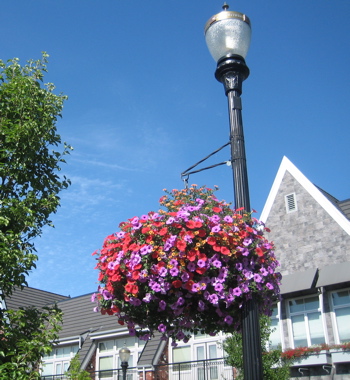 I have to give credit for a large part of the City’s strong interest in flowers to one of the City’s former mayors, Bill Gerber. Bill loved this City. He owned a nursery in Lake Grove called Gerber Gardens. He toured the world looking at gorgeous gardens and brought his love of gardens home to Lake Oswego. It was through Bill’s efforts that Lake Oswego entered into, and won, the America in Bloom competition.

 was the vision of Carl Halvorson (the man who Halvorson Island, the only private island in Oswego Lake, is named after). Developed in 1968, it is built on a dormant volcano, Mt. Sylvania. The population of Mt. Park fluctuates between 8,000 and 8.500 people meaning that just about 1 in 5 people who live in Lake Oswego live in Mt. Park. It also means that the
 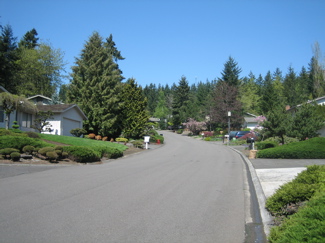 Because the community was planned, and pretty much all built at once, there is a uniformity to the neighborhood with well-cared for lawns and the stately sweep of hillside streets. Pricing goes from a low of $139,900 for a condominium to a high of $699,950 for a 4 bedroom house. Being on a hill, many of the homes and condos have views of Mt. Hood and Portland. Be aware that not all homes in Mt. Park are in the Lake Oswego school district. About 25% of Mt. Park along the North side has Lake Oswego addresses but is in the attendance area for Portland Public Schools. Property values are higher for homes in the Lake Oswego school district.
 For most of the 20th century, oil heat was the primary method of heating homes. If you own or are considering purchasing a home that was built before 1965, chances are pretty good that the house had oil heat. And chances are also pretty good that the oil tank was buried in the ground.
 Lake Grove is located West of Oswego Lake and East of Interstate 5. It includes a vibrant business district along Boones Ferry Rd with many shops, offices, and restaurants. The neighborhood was platted in 1912 and grew as a result of the Goodin Station train stop between Oswego and Tualatin. The old train station and market were long ago converted to a very charming residence and can still be found today. If I were trying to find a word to describe Lake Grove it would be “diverse”. There is just simply a very wide variety of housing and businesses in Lake Grove.
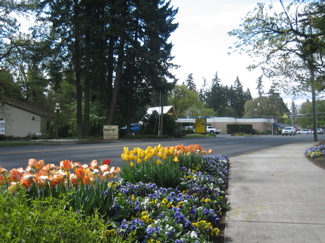 The City of Lake Oswego has spent the last decade doing a major overhaul of its commercial districts. Millenium Plaza Park and the Village Center at the East end of town were completed through this revitalization effort several years ago and have been wildly successful. A similar effort is just beginning in Lake Grove.
  First addition is one of the Portland area’s most charming and desirable places to live. It was platted in 1888 and is actually Lake Oswego’s second oldest neighborhood. (The oldest is the historic old town area near George Roger’s Park). The neighborhood was the first growth outside of Old Town as the economic focus of the town shifted from the production of iron and steel to the pursuit of recreation. The neighborhood has about 30 blocks of historic homes.
 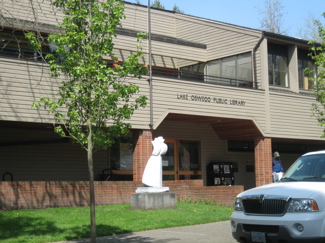 Oswego’s most popular attractions. The neighborhood hosts the
  Adding to the convenience of living in First Addition is the fact that it also contains Lake Oswego’s Tri-Met transit center with bus to downtown Portland and the rest of the metropolitan area.
 If you prefer a newer home, but also want a big back yard, then you will find yourself in a quandary. There are new houses, and there are large lots, but they just don’t seem to be found together. What’s up with that?