
 For most of the 20th century, oil heat was the primary method of heating homes. If you own or are considering purchasing a home that was built before 1965, chances are pretty good that the house had oil heat. And chances are also pretty good that the oil tank was buried in the ground.
Should you be afraid to buy a home with an in-ground tank? No.
Should you be afraid of selling your home if it has an in-ground tank? No.
In both instances the necessary steps that you should take are clearly outlined by the Department of Environmental Quality. As a seller, you want to minimize your liability and be certain that once the house is sold, you will never have the old oil tank come back to haunt you. To do this, you must obtain soil samples to prove that the tank has not contaminated the surrounding soil. If the tank is still in use, the soil samples will prove that the tank had not contaminated the surrounding soil at the time that the house was sold. If tank is no longer in use, you are encouraged to have the tank decommissioned.
Decommissioning the tank involves emptying it of oil, cleaning it out, and filling it with concrete slurry that will harden into a big cement rock in the ground. While decommissioning the tank is voluntary, many lenders and most buyers will make this a condition of the sale. If you do not take the necessary steps to prove that the soil was clean at the time the house was sold, and soil samples taken later show that a contamination has occurred, you can be liable for the cost to clean up the soil even after the house has transferred to a new owner. So, take the proper steps now to assure that you will not have a problem in the future.
Whenever work is done on an in-ground tank, it should be performed by a licensed and bonded contractor who is certified with the DEQ. After the work is completed, a certificated of compliance will be issued. This is paperwork that needs to be saved and transfered with the property to every subsequent owner. Cost to do soil testing will run about $200-$400. Cost of decommissioning will run about $800 to $1,200. Can it cost more, yes, but that is a minority of the cases.
If you are wanting to buy a house with an in-ground oil tank, should you be afraid to purchase? No. Simply make the soil testing and the decommissioning of the tank a condition of the purchase. You are strongly advised to get this taken care of before you buy the house. If you buy the house with an in-ground tank, and you discover later that the tank has leaked, you have now taken ownership of the problem.
How bad can it get? There certainly are horror stories of soil clean up costs running into the thousands and thousands of dollars. In my 20 years of selling real estate, the most costly clean-up I have encountered involved bringing in a backhoe to remove a tank and dig a hole about 15 feet in diameter. It cost the seller $8,000.
Information on oil tanks are surprisingly undocumented. There are not good resources for looking up records about in-ground tanks. The DEQ does not regulate in-ground tanks beyond requiring that they be reported if they have leaked. Then, the DEQ does open a file on them and there is a process to clean up the contamination and get the file closed. However, if no leak has been reported to the DEQ, they will not have a record of the tank. And do not rely on city records or fire department knowledge of in-ground tanks. This means that even if a seller has no knowledge of an in-ground tank, you may want to consider having the yard of an older home scanned with a metal detector to confirm that no tank exists in the yard.
In all cases, it is best to take every precaution to be in compliance with soil testing and tank decommissioning when you buy or sell a home. Taking the proper steps now will save both buyers and sellers heartache later.
 The Palisades neighborhood is located on the South side of Lake Oswego, and is roughly the area bounded by: Stafford/McVey along the south & southeast, Southshore Rd. (down to the lake) along the north, Blue Heron, and then north & east of the Westridge Elementary School area.
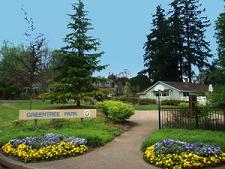 It is a lovely neighborhood with a mix of housing ranging in list price currently from $489,900. to $5,950,000.
 Amenities include the Municipal Golf Course, parks, a dog park, community swimming pool, and the new “boutique” senior living center, “The Stafford”, which is situated across the street from the high school, three athletic fields and yet another dog park. This location, we are told, was intentionally chosen in order to meld the young and the elderly in a real community atmosphere where all phases of life are acknowledged and celebrated.

 One of the best things about Palisades (in my humble opinion) is Palisades Market. This is a locally-owned market with some of the nicest people you’d ever want to meet making sure that you’ve found every little thing.
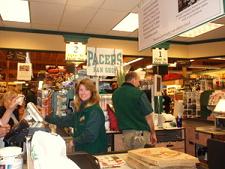 There is an adjoining post office annex & the Coffee Nook, a florist, a deli, wine shop, specialty meat shop, bakery and often dinner cooked & ready to be served for take-home by yet another friendly employee… a chef this time. The store is owned by Bob Lamb, Gale Casko, and Nick Goldsmith who is ever-present and always catering to customers’ needs.
 Originally a much smaller store it was located where the pizza parlor, restaurant and cleaners are now, moving in 1997 to its current location just up the block, and boasting 25,000 SF of friendly service.
 Lake Grove is located West of Oswego Lake and East of Interstate 5. It includes a vibrant business district along Boones Ferry Rd with many shops, offices, and restaurants. The neighborhood was platted in 1912 and grew as a result of the Goodin Station train stop between Oswego and Tualatin. The old train station and market were long ago converted to a very charming residence and can still be found today. If I were trying to find a word to describe Lake Grove it would be “diverse”. There is just simply a very wide variety of housing and businesses in Lake Grove.

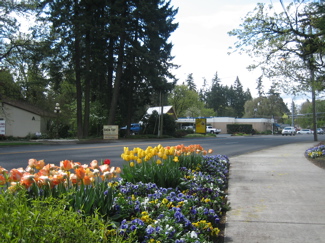 The City of Lake Oswego has spent the last decade doing a major overhaul of its commercial districts. Millenium Plaza Park and the Village Center at the East end of town were completed through this revitalization effort several years ago and have been wildly successful. A similar effort is just beginning in Lake Grove.
 First addition is one of the Portland area’s most charming and desirable places to live. It was platted in 1888 and is actually Lake Oswego’s second oldest neighborhood. (The oldest is the historic old town area near George Roger’s Park). The neighborhood was the first growth outside of Old Town as the economic focus of the town shifted from the production of iron and steel to the pursuit of recreation. The neighborhood has about 30 blocks of historic homes.
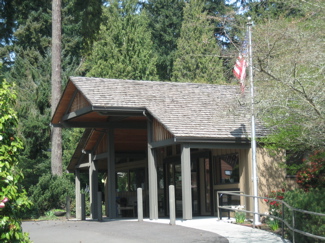
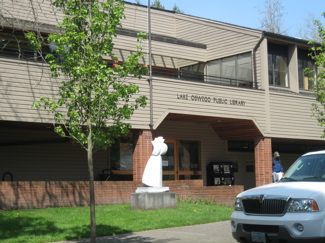 Oswego’s most popular attractions. The neighborhood hosts the
 Adding to the convenience of living in First Addition is the fact that it also contains Lake Oswego’s Tri-Met transit center with bus to downtown Portland and the rest of the metropolitan area.