
Neighbors in Lake Oswego have been educating each other about something called Orangeburg pipe, so I thought it might be something you’d like to know about. Orangeburg is a kind of sewer piping that was manufactured and used throughout the country between 1940 and approximately 1972, until ABS plastic piping was introduced and replaced its use.
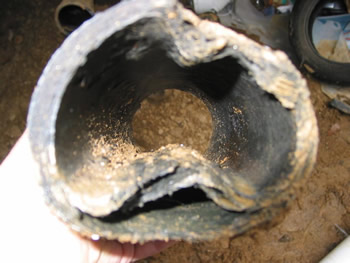 The Fibre Conduit Company of Orangeburg, N.Y. was a major manufacturer of this kind of pipe, and with its widespread use, changed its name to the Orangeburg Pipe Co. — thus the common name of the product. If your home was built during this period, there is a good chance that you have this kind of sewer pipe lurking underground, so it is good to know what this could mean to you as either a homeowner, or someone contemplating a purchase.
Orangeburg pipe is actually “bituminized” fiber drain and sewer pipe 2” – 18” in diameter. Basically it was made of cellulose fibers impregnated with hot coal pitch and treated under pressure with a water-resistant adhesive. The joints of this pipe are gasket-less, and the pipe often softens and deforms with age which allows for root intrusion and general breakdown with time. Its lifespan is approximately 50 – 60 years, and so it is, generally speaking, at the end of its life cycle — which is why you should know about it.
On my block, it became an issue and a hot topic of conversation a few years back. Since then, when I bring it up, I often find it is a subject with which people are unfamiliar unless their lives have been directly affected. One set of neighbors had their sewage back up into their basement… not a pretty picture, and had to replace their sewer line in a hurry and under duress. Other neighbors have investigated their pipes and ordered their preemptive replacement in order to avoid the unpleasant fate of the aforementioned neighbors. One had sewer pipes replaced as a part of closing a real estate sale, and another decided on a preemptive replacement only to discover that their sewer pipe was NOT Orangeburg after opening up a big hole in their front yard.
So, if you decide you’d like to have a definitive answer to the Orangeburg question, you may wish to call a company that works with sewer lines to come perform a “sewer scope” at a cost to you of approximately $100. – $150. They will insert a camera down into the line, and be able to tell the condition of the pipes, whether there is root intrusion, and yes, whether you have Orangeburg pipes getting ready to collapse. AND, to top it off, they’ll leave you with a DVD which you may view from time to time for your entertainment… or not.
If you are a prospective home buyer, you will want to assess whether the home you are purchasing is a candidate for possible Orangeburg sewer pipes, and make the sewer scope a part of your home inspection process.
Photo courtesy of Mike Butkus.
 Yes, you should be concerned.